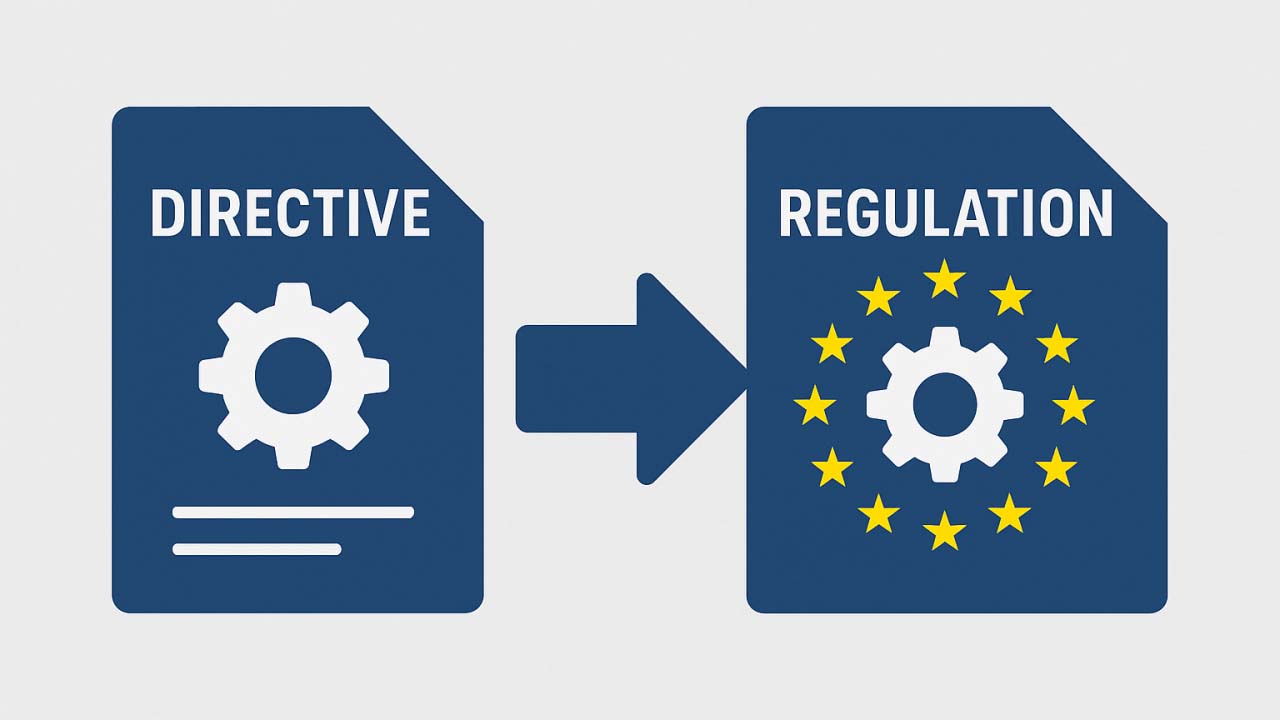

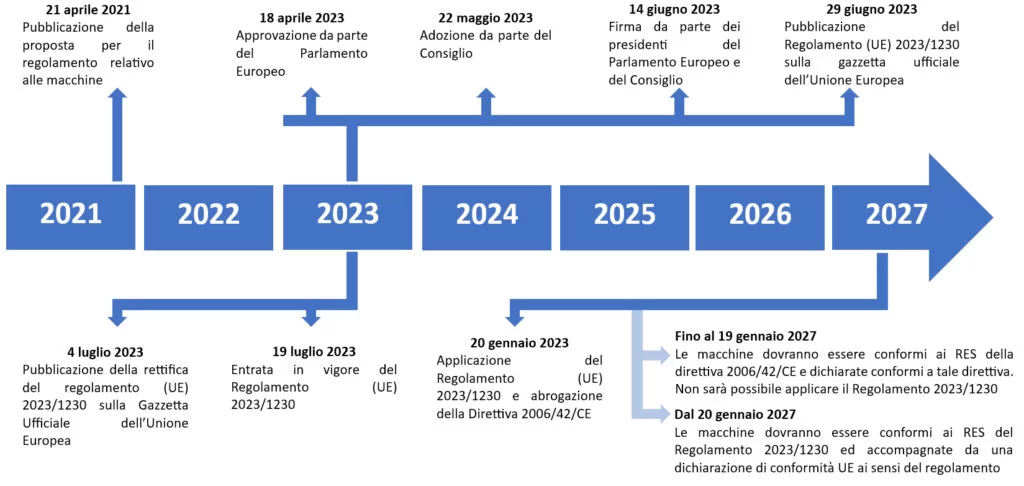
 Following a lengthy process that began in 2021, Regulation (EU) 2023/1230 (known as the new Machinery Regulation) will officially become binding and mandatory as of January 20, 2027, definitively replacing the long-standing Machinery Directive 2006/42/EC. Unlike the old directive, it applies directly in all Member States without the need for national transposition laws, thereby harmonizing rules across the European Union. Key changes focus on adapting to new technologies, the digitization of documentation, and clearly defining responsibilities regarding modifications to machinery.
WHAT CHANGES
1. Digital transition and new technologies
The text addresses the profound technological changes that have occurred over the last twenty years:
Mandatory cybersecurity: Control systems performing safety functions must be designed to prevent cyberattacks or external access (whether malicious or accidental) from causing dangerous behavior or machine failure.
Artificial Intelligence and Software: Software with safety functions is now formally classified as a “safety component.” Regulations also explicitly cover systems with self-evolving behavior (AI) and autonomous mobile machinery (such as AGVs).
2. Digital manuals and declarations
The management of administrative documentation is undergoing a radical shift to reduce printing costs:
Digital instructions: Manufacturers may provide user manuals and the declaration of conformity in digital format (e.g., via a QR code on the machine).
Accessibility requirements: Online documentation must remain downloadable, printable, and accessible for at least 10 years after the product is placed on the market.
Right to a paper copy: Customers retain the right to request a paper version free of charge, which the manufacturer must provide within one month.
3. The concept of “Substantial Modification”
A regulatory gap is finally being closed by legally defining what constitutes a substantial modification to a machine already in service:
This occurs when a physical or logical modification (e.g., a software change) not foreseen by the original manufacturer introduces new hazards or increases existing risks.
Anyone carrying out such a modification (including the user or employer) effectively assumes the role and responsibilities of the manufacturer. They are therefore required to conduct a new conformity assessment and affix a new CE mark for the modified part. 4. New obligations for the supply chain
The regulation clearly extends and specifies the responsibilities of all economic operators involved:
In addition to manufacturers, specific verification and compliance obligations are also introduced for importers and distributors.
The old “EC Declaration of Conformity” is renamed the “EU Declaration of Conformity.”
The “Technical File” is officially renamed “Technical Documentation.”
In addition to standard identification details, the machine’s nameplate must include a unique contact email address or an optical link to enable quick identification of the manufacturer.
And what about motorized closures?
Roller shutters, up-and-over doors, folding and sliding gates, high-speed PVC doors, and sectional doors are classified as “machinery” in every respect when motorized. Consequently, the entry into force of Regulation (EU) 2023/1230 (effective January 20, 2027) introduces crucial changes for installers, manufacturers, and owners. This market—also governed by the UNI EN 13241 product standard—will be significantly impacted in two main areas: the retrofitting of manual doors with motors and the integration of smart/home automation systems.
1. Post-installation “Motorization” becomes a Substantial Modification
Converting an existing manual shutter or gate into a motorized one by adding an electric motor is a common procedure, but the rules are changing:
The party performing the motorization becomes the Manufacturer: The new regulation clarifies the definition of a “substantial modification.” If a motorization system not envisaged by the original manufacturer is added (thereby introducing risks of crushing, shearing, or drawing-in), the installer assumes the legal obligations of the manufacturer.
Mandatory New CE Marking: Installers can no longer simply issue a declaration for the motor alone. They must conduct a new risk assessment of the entire system (door + motor), compile the Technical Documentation, and affix a new CE marking plate to the door unit.
2. Cybersecurity and remote control (Apps and Home Automation)
Modern roller shutters and sectional doors are increasingly connected to home automation systems and Wi-Fi, or controlled via smartphones.
Protection against cyberattacks: The regulation introduces a requirement to protect control and safety circuits against malicious or accidental external access. Interconnectivity must not allow a hacker to force the door open remotely or to disable photocells or safety edges.
Software as a safety component: If the safe operation of the barrier (e.g., reversing direction upon encountering an obstacle) relies on software or a dedicated app, that software must be independently validated and CE marked.
3. Maintenance manuals and QR codes
The large volumes of paperwork traditionally supplied with industrial doors or condominium garage doors are being replaced by digital alternatives:
QR codes on the door: Manufacturers and installers can provide the user manual, maintenance instructions, and EU Declaration of Conformity directly in digital format (e.g., by printing a link or QR code on the door’s identification plate).
10-year availability: Files must remain accessible online and downloadable for at least 10 years from the date of installation. The obligation to provide a free paper version within one month remains, but only if the end customer explicitly requests it.
4. Liability for condominium administrators and employers
For those managing commercial properties or condominiums, protections are increasing, but so is the level of scrutiny:
If an administrator commissions the repair of an old up-and-over door that alters its original operation (e.g., changing the control unit logic or the type of photocells to address wear and tear), they must ensure that the technician issues updated documentation in compliance with the new regulation. An uncertified, substantial modification renders the door non-compliant, exposing the client to serious civil and criminal liability in the event of an accident.
CONTACT US FOR FURTHER INFORMATION.